

Roundhouses and Locomotive Sheds
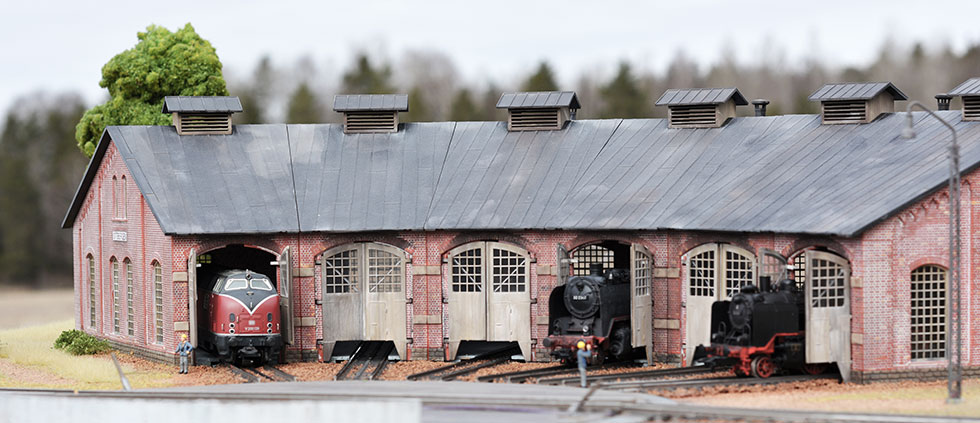
6-port Round house in H0-scale built from KIBRI Ottbergen-kit
For more than a century, locomotive sheds and roundhouses were among the most important structures found on a railway. While stations handled passengers and freight yards sorted wagons, the locomotive facilities kept the engines running. Every steam locomotive required regular inspection, lubrication, cleaning and maintenance, and much of this work was performed inside the locomotive shed or roundhouse.
Different Types of Roundhouses and Locomotive Sheds
The simplest locomotive facilities consisted of a single-track shed, often referred to as a one-port locomotive shed. These were common on branch lines and at smaller stations where only one locomotive was assigned. Larger facilities might have two or three tracks, allowing several locomotives to be stored under one roof. As railways expanded and locomotive fleets grew, larger roundhouses became common. These were usually arranged in a semicircular or circular shape around a turntable.
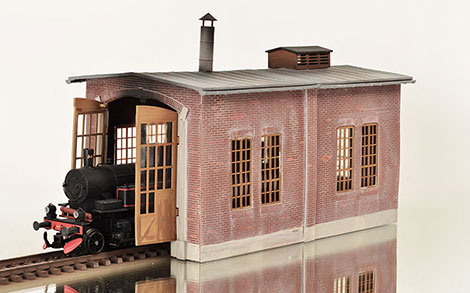
1-port Locomotive Shed in H0-scale built from Modelrailroad 3D-kit
The turntable allowed locomotives to be rotated and directed into any available stall. Large railway terminals could have roundhouses with ten, twenty or even more stalls, housing everything from small switching locomotives to the largest express passenger engines.
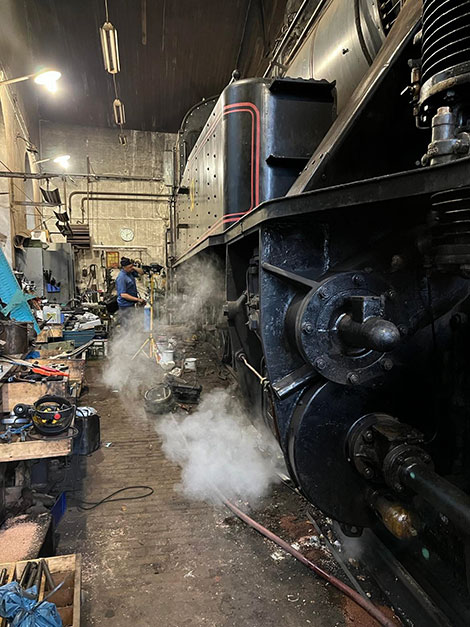
2-port Locomotive shed interior captured in Sösdala, Sweden
Maintenance Inside the Roundhouse
The shed itself was primarily used for inspection, maintenance and storage. Inside the building, mechanics checked running gear, inspected brake systems and lubricated bearings, rods and valve gear. Shelves along the walls often contained spare parts such as lubricator components, brake shoes, lamps, tools and replacement fittings. Workbenches were equipped with vises, grinders and hand tools used for daily repairs. Many roundhouses also contained inspection pits beneath the tracks. These allowed workers to access the underside of locomotives for maintenance and lubrication. One important task was preparing locomotives for the next day. Large steam locomotives were time-consuming to heat from cold. To save both time and fuel, locomotives often remained under steam overnight. A small fire, known as a “banked” or “slow” fire, was maintained in the firebox. This kept the boiler warm and significantly reduced the time required to prepare the locomotive for service the following morning.
Because locomotives could continue producing smoke while standing indoors, roundhouses were equipped with smoke jacks or roof ventilators positioned above each stall. These carried smoke and fumes outside while allowing maintenance crews to work in a safer environment.
Modeling Roundhouses and Locomotive Facilities
Roundhouses are among the most attractive structures a model railroader can add to a layout. They provide an operational purpose, create a natural focal point and offer endless detailing opportunities.
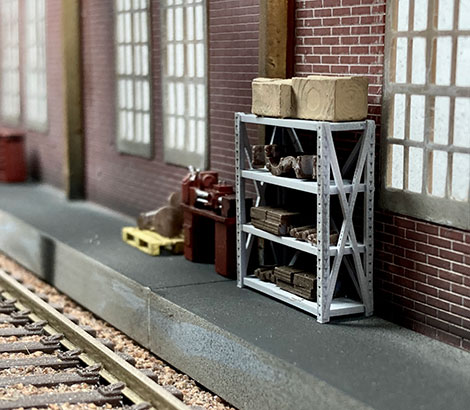
3D-printed Engine shed with interior
Painting and Weathering
Most roundhouses were built from brick and accumulated decades of dirt, soot and smoke stains. This makes them ideal candidates for weathering. A convincing brick finish often begins with a base coat of brick red, brown or orange tones. Once dry, a light gray or off-white wash can be worked into the mortar joints to represent grout between the bricks. Excess wash is wiped from the brick surfaces, leaving the mortar lines highlighted. Weathering powders, airbrushing and washes can then be used to add soot around smoke vents, grime beneath windows and rust streaks around metal details.
The roof usually shows the heaviest weathering due to years of smoke and exhaust deposits. Adding interior details such as workbenches, spare parts, oil drums, tools and inspection pits further enhances realism. Combined with realistic lighting, these details transform the structure from a simple building into a believable maintenance facility. Whether modeled as a small one-port locomotive shed on a branch line or a large roundhouse surrounding a turntable, locomotive facilities remain one of the most iconic and rewarding scenes that can be added to a model railroad. Because locomotives could continue producing smoke while standing indoors, roundhouses were equipped with smoke jacks or roof ventilators positioned above each stall. These carried smoke and fumes outside while allowing maintenance crews to work in a safer environment.