

Railroad Basics Explained
Anyone interested in railways benefits from understanding a few basic terms.As the model railway becomes larger and more complex, it also becomes more interesting to understand how railway traffic and track planning work in real life. To even begin approaching this, it is useful to know a few basic concepts.
Let us first note that Swedish railways normally use left-hand running. This affects the expected direction of trains on a given track, but also which side of the track signals, catenary masts and other equipment should be placed.
Track Types
Running Tracks and Sidings

Main and Secondary Train Routes
A main train route uses the main running track. At double-track stations there are therefore two main train routes.
Railway Locations
Station
A station is a place where the order of trains can be changed, for example through a train meeting, overtaking, crossover movements between both tracks on a double-track line, branching to different lines, or where a train movement begins or ends in an operational safety sense. Geographically, the station lies between the entry signals, or between an entry signal and another end point for a train route at terminal stations. Sometimes two stations border each other without an intervening line section.
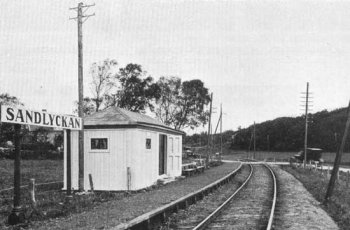
The halt has no turnouts or signals.
Platform Stop Within a Station
A platform stop within a station area is a place where passengers board and alight, but it has a different name from the station itself.
Halt
Halt is a stop along the line where trains can stop. Halts most often have a manually operated halt-sign to indicate to the approachig train to stop. Halts are missing turnouts and signals.
Line Location
Line Location is a place along the line, where there is no station, or turnout or movable bridge. A Line Locationen may vary from having just one turnout and a short stub-end siding to a large disused (downgraded) station yard.
Interlocking Area
An interlocking area consists of two or more stations whose station limits have no intervening line sections and where the stations are supervised by the same train dispatcher. The interlocking area may be locally controlled or remotely controlled, and the stations may share one interlocking or have separate interlockings.
Railway Operations
Train
In strict railway terminology, a train is a type of movement, to be contrasted with other forms of movement such as a wagon transfer movement or shunting. Train movement is the type of movement used for passenger traffic and long-distance freight traffic.
Train movement and Running tracks
Train movements take place on running tracks. Train movements refer to movements of trains according to a timetable. Other types of movements include wagon transfer movements, shunting or engineering vehicle movements.
Shunting
Shunting means movements made to move railway vehicles within or immediately outside a traffic location. It includes movements of railway vehicles at a railway location, for example to couple vehicles together, uncouple them or move them. This may be done with dedicated shunting locomotives, with the train locomotive, or in individual cases by other means such as manual force, gravity, a road vehicle or similar. One example of a shunting movement is a run-around move, where a locomotive at a train's terminal station is moved from one end of the train to the other. Shunting at a station normally takes place within the station limits, but in exceptional cases it may be allowed outside the station limit if this is required, for example to pass a turnout that must be changed. Shunting may also take place at a line location, but the movement to and from the line location normally takes place as a wagon transfer movement. On sidings, all movements are shunting.
Switching
See shunting above. A common US term for sorting and assembling wagons.
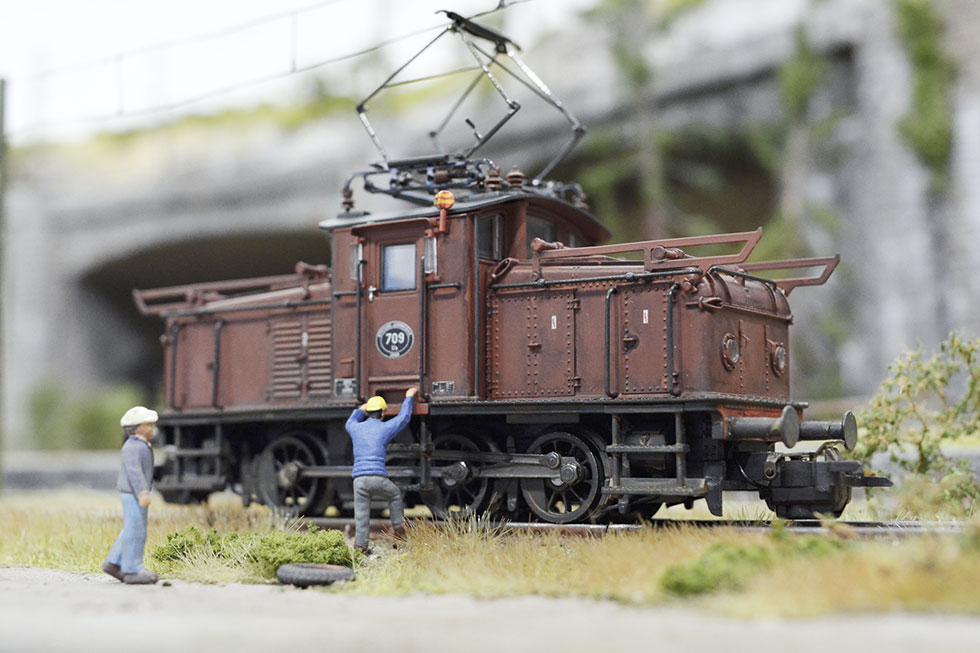
The shunting locomotive Ub709 (Märklin H0 model with Telex couplers)
Wagon Transfer Movement
Unlike a train, which always runs from one station to another, a wagon transfer movement may for example run from a station out onto the line and later return to the same station, typically for track work, or from a station to a line location, typically for shunting wagons on industrial sidings. While a wagon transfer movement is in progress, the station section, meaning the line between two adjacent controlled stations, is blocked. This means that the wagon transfer movement must be completed before a train is allowed to use the section. Several wagon transfer movements may, however, take place at the same time, for example if several different sets of vehicles must be moved to a work site on the line.
/ Martin T.