| - MRR TUTORIALS - BENCHWORK - OVERVIEW |  |
 |
SITE MAP |
Overview other designs of benchwork
L-Girder benchwork
This type of benchwork uses L-shaped girders made from two pieces of lumber (usually 1x2 and 1x3) fastened together. The L-girder design is strong and allows for easy attachment of risers and sub-roadbed. It's particularly useful for layouts with varying elevations.Solid table top or Plywood board
8x4' sheet of plywood. Easy to set up and rebuild. Limit ways to have lanscape below track level.
Hollow Core Door Benchwork
Using a hollow core door as the base for a layout is a simple and cost-effective method. It's lightweight and provides a flat, sturdy surface.
This is often used for small to medium-sized layouts .
Cookie-Cutter Benchwork
This method involves cutting the sub-roadbed from a sheet of plywood in a way that allows sections to be elevated or lowered to create hills and valleys.
It's often used in combination with open grid or L-girder benchwork.
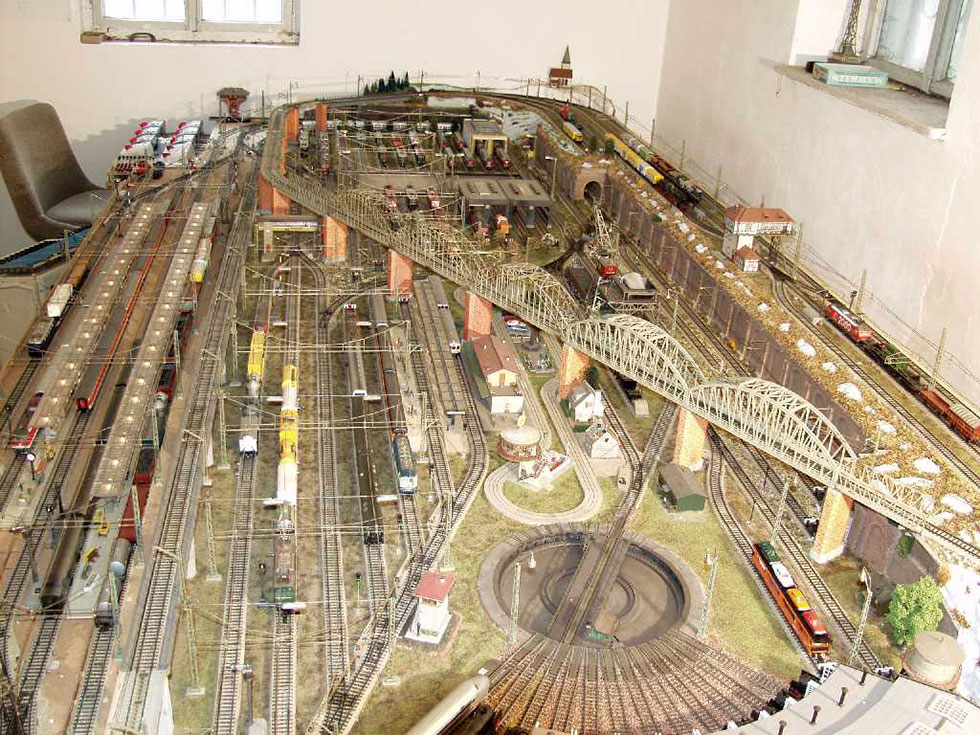
Model Railroad built on solid Plywood sheets is often looking flat, is noicy and lack realism. This was common in the early days of Model railroading 1940-70 (Builder Darko Vöfl)
Framework for Shelf Layouts
These are narrow, wall-mounted layouts that are ideal for small spaces. They can be supported by brackets or a simple frame attached to the wall. Shelf layouts are great for linear track plans and switching operations .
Modular Benchwork
This involves building the layout in sections or modules that can be easily connected or rearranged. It's popular for club layouts or for modelers who may need to move their layout. Standards like those from the National Model Railroad Association (NMRA) or Free-mo are often used to ensure compatibility between modules.
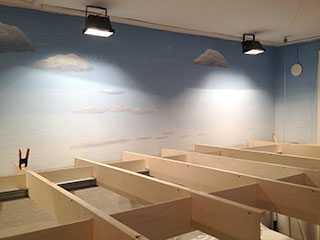 L-girdle type benchwork |
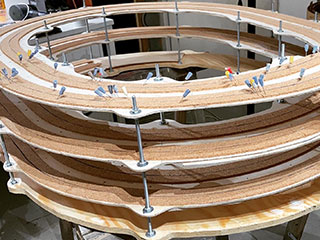 Helix based on threaded rods |